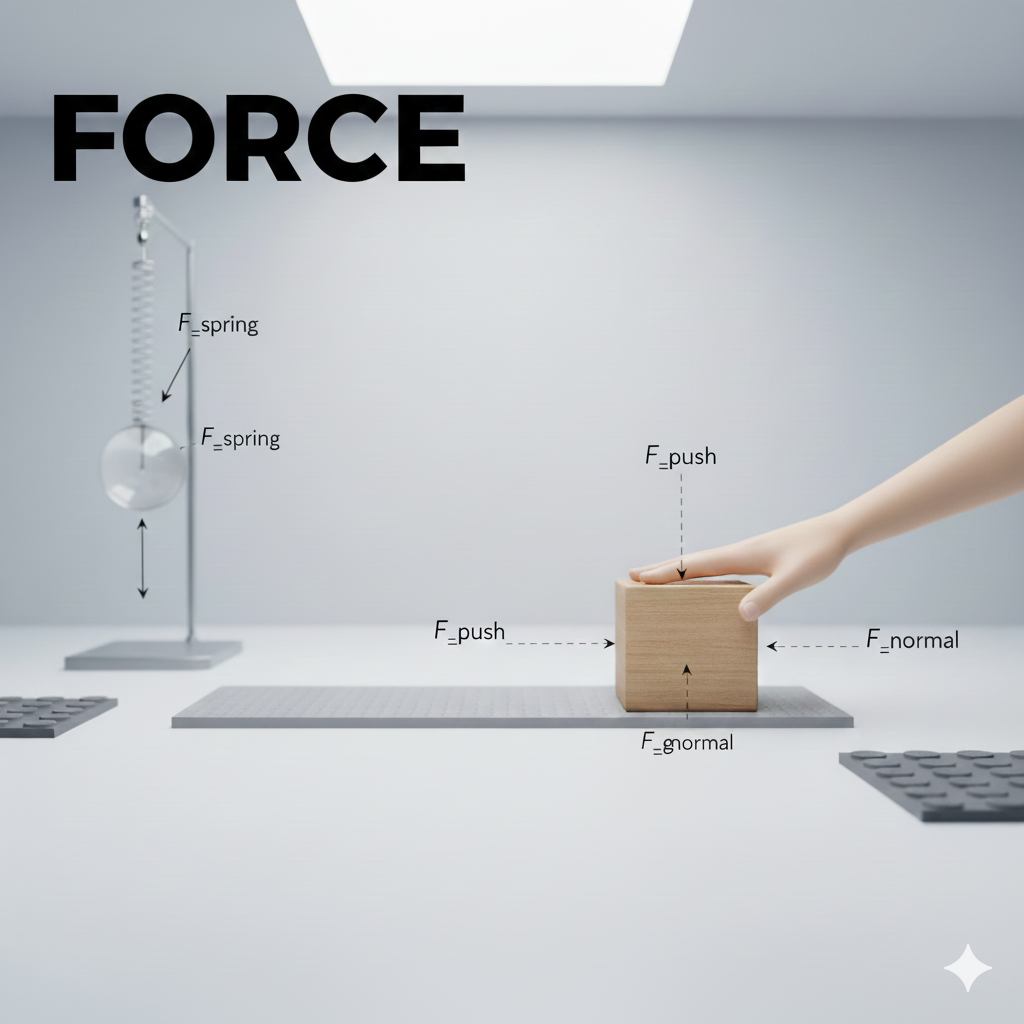
What is Force?
Formally, a force is an external influence that, when unopposed, will change the motion of an object.
It represents a push or a pull. It can change an object’s:
-
Speed: Making it go faster or slower.
-
Direction: Changing the path it is traveling.
-
Shape: Compressing or stretching an object.
Forces are measured in Newtons (N).
-
Vector Quantity: it is a vector, meaning it has both magnitude (how strong it is) and direction (where it is pointing).
-
The Newton (N): The standard unit of force is One Newton is defined as the amount of force required to accelerate 1 kilogram of mass at a rate of 1 meter per second squared( 1N = 1 kg . m/s² ).
Work and Energy
The Core Mathematics of Force
Force is defined mathematically by Newton’s Second Law of Motion. If the mass of an object is constant, the formula is:
F = m×a
Where:
-
F = Force (Newtons).
-
m = Mass (Kilograms).
-
a = Acceleration (m/s²).


Effects of Force
When a net force is applied to an object, it can:
-
Start a stationary object moving.
-
Stop a moving object.
-
Change the speed (accelerate or decelerate).
-
Change the direction of motion.
-
Change the shape or size of an object (deformation).
Types of Forces
Forces are generally categorized into two main groups based on how they interact with matter:
A. Contact Forces
A contact force is any force that requires physical interaction between two objects. The force is transmitted through the point or surface where the objects meet.
-
Frictional Force: Opposes motion between surfaces (e.g., brakes on a car).
-
Tension Force: Transmitted through a string, rope, or cable when pulled tight.
-
Normal Force: The support force exerted by a surface (e.g., a table pushing up on a book).
-
Air Resistance: A type of friction that acts on objects moving through the air.
B. Non-Contact (Field) Forces
A non-contact force (also known as a field force) acts on an object from a distance without any physical touch. These forces are mediated by “fields” that surround the objects.
-
Gravitational Force: The attraction between any two masses (like Earth and the Moon).
-
Electromagnetic Force: Acts between electrically charged particles.
-
Magnetic Force: The attraction or repulsion between magnetic poles.
Balanced vs. Unbalanced Forces
Balanced Forces:
Balanced forces occur when all the forces acting on an object are equal in magnitude but opposite in direction. They cancel each other out perfectly.
-
Net Force: F_net = 0.
-
Effect on Motion: There is no change in motion.
-
If the object is at rest, it stays at rest.
-
If the object is moving, it continues to move at a constant velocity (same speed and same direction).
-
-
Example: A book resting on a table. The downward force of gravity is perfectly balanced by the upward “normal force” from the table.
Unbalanced Forces:
Unbalanced forces occur when the forces acting on an object are not equal. This results in a leftover force in one specific direction.
-
Net Force: F_net ≠ 0.
-
Effect on Motion: They cause acceleration. The object will:
-
Start moving (if it was still).
-
Speed up or slow down.
-
Change its direction.
-
-
Example: A game of Tug-of-War where one team is much stronger. The rope will accelerate toward the stronger team because the forces are unequal.
Comparison Summary
| Feature | Balanced Forces | Unbalanced Forces |
| Net Force (F_net) | Zero (0 N) | Non-zero (> 0 N) |
| Change in Speed | None (Constant) | Object speeds up or slows down |
| Change in Direction | None | Object may turn or change path |
| State of Equilibrium | Object is in equilibrium | Object is NOT in equilibrium |
The 4 Fundamental Forces of Nature
On a subatomic and cosmic level, all forces in the universe are derived from four fundamental interactions:
| Force | Description | Range |
| Strong Nuclear | Holds protons and neutrons together in the nucleus. | Very Short |
| Electromagnetic | Acts between charged particles; responsible for chemistry and light. | Infinite |
| Weak Nuclear | Responsible for radioactive decay and nuclear fusion. | Very Short |
| Gravity | Attracts objects with mass; weakest but works over the largest scales. | Infinite |
——————————————————————————————————————————————————————-
Newton’s Three Laws of Motion
Sir Isaac Newton’s three laws of motion describe how forces interact with objects to create movement. These laws are the foundation of classical mechanics and explain everything from why you wear a seatbelt to how rockets launch into space.
1. Newton’s First Law: The Law of Inertia
“An object remains at rest, or in uniform motion in a straight line, unless acted upon by a net external force.”7


Inertia is the inherent “stubbornness” of matter. It is not a force; it is a property. The more mass an object has, the more inertia it has (it’s harder to start moving a boulder than a pebble).
-
Inertia of Rest: A carpet stays still until you shake it; dust falls off because the dust wants to stay at rest while the carpet moves.
-
Inertia of Motion: If you are in a bus and it stops suddenly, you lurch forward because your upper body “wants” to keep moving at the bus’s previous speed.
2. Newton’s Second Law: Law of Acceleration
“The rate of change of momentum of an object is proportional to the applied force and takes place in the direction of the force.”11

While we often use F = ma, the more precise definition involves Momentum (p = mv).
The Formula Derivation:
If an object’s velocity changes from u (initial) to v (final) over time t:
-
Initial Momentum: p1 = mu.
-
Final Momentum: p2 = mv.
-
Change in Momentum: Δp = m(v – u)
-
Rate of Change: m(v-u)/t = ma (since, v-u/t is acceleration).
Therefore, F = ma. This law tells us that if you double the mass, you need double the force to get the same acceleration.
3. Newton’s Third Law: Action and Reaction
“To every action, there is always an equal and opposite reaction.”

Crucially, these two forces act on different objects, which is why they don’t cancel each other out.
-
Action: Your foot pushes the ground backward while walking.
-
Reaction: The ground pushes your foot forward with equal force.
-
Example (Recoil): When a gun fires a bullet, the force pushing the bullet forward is matched by an equal force pushing the gun backward (recoil).
Summary Table
| Law | Also Known As | Core Idea | Practical Example |
| 1st Law | Law of Inertia | Objects resist changes in motion. | A ball won’t move unless kicked. |
| 2nd Law | F = ma | More force = more acceleration; more mass = less. | Pushing a car vs. pushing a bike. |
| 3rd Law | Action/Reaction | Forces come in equal/opposite pairs. | Recoil of a gun when fired. |
RELATED POSTS
View all