Sustainable development
December 27, 2025 | by monuyadaver@gmail.com

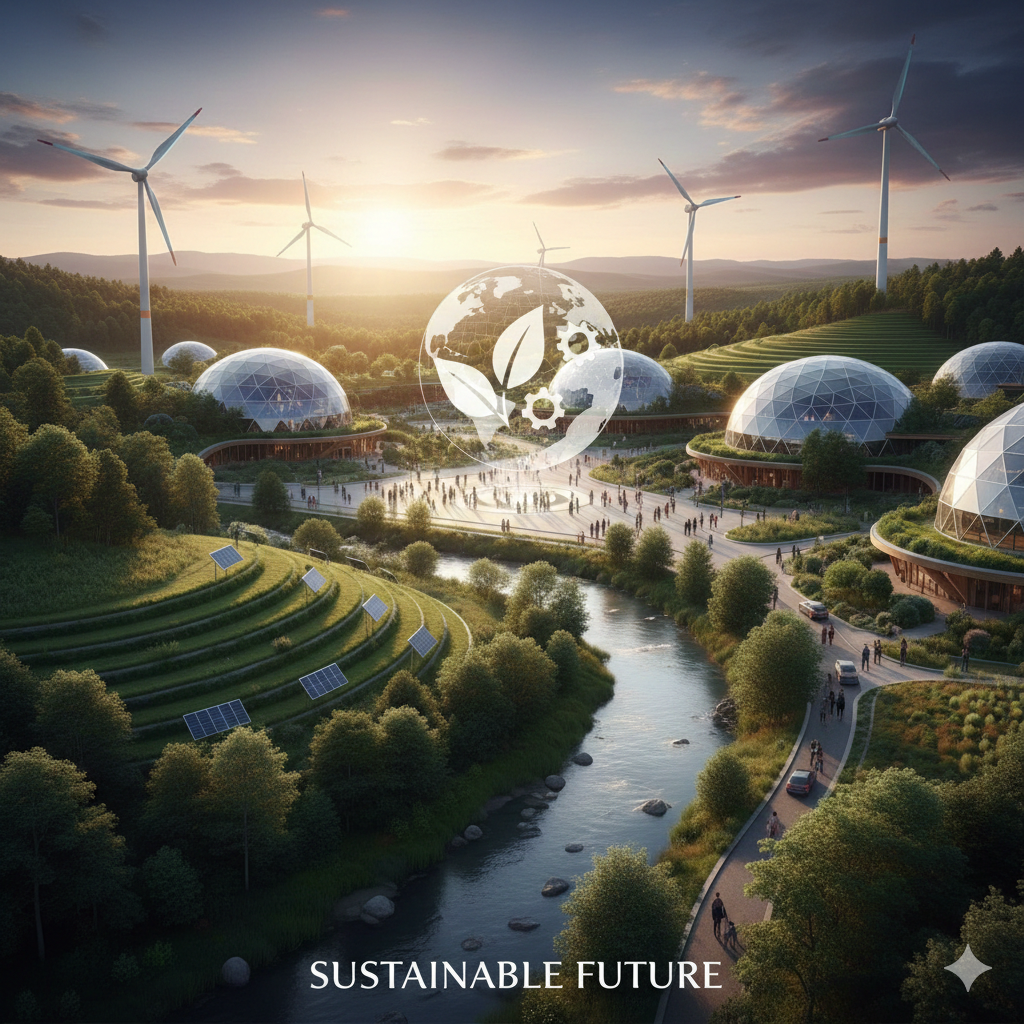
Sustainable development
Sustainable development is the practice of growing as a society—economically and socially—without exhausting the natural resources or damaging the environment that future generations will need to survive.
The most widely accepted definition comes from the 1987 UN Brundtland Report:
“Sustainable development is development that meets the needs of the present without compromising the ability of future generations to meet their own needs.”
Force
The Three Pillars of Sustainable development
The Three Pillars of Sustainability—often called People, Planet, and Profit—is a framework used to ensure that growth is balanced and long-lasting. If any one pillar is weak, the whole system becomes unstable.


1. The Environmental Pillar (Planet)
This is often what people think of first. It focuses on the integrity of our ecosystems and the responsible management of natural resources.
-
Key Focus: Reducing carbon footprints, waste management, protecting biodiversity, and switching to renewable energy.
-
The Goal: Ensuring we don’t consume resources faster than the Earth can replenish them.
2. The Social Pillar (People)
A society cannot be sustainable if its people are not healthy, safe, and educated. This pillar focuses on human well-being and equity.
-
Key Focus: Human rights, fair labor practices, gender equality, community health, and access to education.
-
The Goal: Creating a fair society where everyone has the opportunity to thrive and basic needs are met.
3. The Economic Pillar (Profit)
Sustainability doesn’t mean “no profit”; it means responsible profit. Economic growth must be viable over the long term without relying on the exploitation of the other two pillars.
-
Key Focus: Job creation, ethical business practices, innovation, and moving toward a “circular economy” where waste is designed out of the system.
-
The Goal: Maintaining a healthy economy that supports the standard of living without depleting natural or human capital.
How They Intersect
The true power of this framework lies in where the pillars overlap:
-
Social + Environmental = Bearable: Life is livable, but economic constraints might limit progress.
-
Environmental + Economic = Viable: Business is efficient and “green,” but social inequality may still exist.
-
Social + Economic = Equitable: Wealth is distributed fairly, but the environment might be suffering.
-
The Center (Intersection of all three) = Sustainable: This is the “sweet spot” where a project or society is truly sustainable.
History of Sustainable development
The history of sustainable development is a journey from local resource management to a global framework for human survival. While it feels like a modern “buzzword,” its roots reach back centuries.
1. Early Roots: The Science of Forestry
Long before the United Nations existed, the concept emerged from a practical crisis: timber shortages.
-
1713: Hans Carl von Carlowitz, a German mining administrator, coined the term Nachhaltigkeit (sustainability) in his book Sylvicultura Oeconomica. He argued that we should only harvest as much wood as the forest can naturally regrow.
-
18th–19th Century: Thinkers like Thomas Malthus (1798) warned that population growth would eventually outpace food production, planting the early seeds of “limits to growth.”
2. The 1960s Awakening: Modern Environmentalism
The mid-20th century saw a shift from managing resources to protecting the planet from industrial damage.
-
1962: Rachel Carson published Silent Spring, exposing the dangers of pesticides. This book is widely credited with launching the modern environmental movement.
-
1968: The Club of Rome was formed. Their 1972 report, The Limits to Growth, used computer modeling to predict that the current path of industrial expansion was physically impossible to maintain.
-
1972: The Stockholm Conference (UN Conference on the Human Environment) was the first major global meeting to treat the environment as a central political issue.
3. The 1980s: Defining the Concept
This is when “Sustainable Development” as we know it today was officially defined.
-
1980: The World Conservation Strategy first used the term “sustainable development” in a global policy context.
-
1987: The Brundtland Report. Led by Gro Harlem Brundtland, the UN’s World Commission on Environment and Development published Our Common Future. It provided the gold-standard definition:
“Development that meets the needs of the present without compromising the ability of future generations to meet their own needs.”
4. The 1990s to 2012: The Era of Summits
Governments began moving from definitions to action plans.
-
1992: The Rio Earth Summit. A landmark event where Agenda 21 was adopted. It established the “three pillars” of sustainability: Economic, Social, and Environmental.
-
2000: Millennium Development Goals (MDGs). The UN set eight goals to be achieved by 2015, focusing heavily on poverty, health, and education.
-
2012: Rio+20. This conference initiated the process of replacing the MDGs with a more comprehensive, universal set of goals.
5. 2015–Present: The 2030 Agenda
We are currently in the implementation phase of the most ambitious sustainability plan in history.
-
2015: The UN adopted the 17 Sustainable Development Goals (SDGs). Unlike previous goals, these apply to all countries, not just developing ones.
-
2015: The Paris Agreement was signed, legally binding nations to limit global warming to well below 2°C.
Key Milestones at a Glance
| Year | Milestone | Significance |
| 1713 | Carlowitz’s Forestry Work | First mention of “sustainability” in resource management. |
| 1972 | Stockholm Conference | Environment enters global diplomacy; UNEP created. |
| 1987 | Brundtland Report | Created the modern definition of Sustainable Development. |
| 1992 | Rio Earth Summit | Birth of Agenda 21 and the Climate Change Convention (UNFCCC). |
| 2015 | 2030 Agenda (SDGs) | Modern 17-goal framework adopted by 193 countries. |
The Seven Guiding Principles of Sustainable development
To make “sustainability” actionable, experts use several governing principles:
-
Intergenerational Equity: We are “borrowing” the Earth from our children, not inheriting it from our ancestors.
-
The Precautionary Principle: If an action might cause severe or irreversible harm to the public or the environment, the burden of proof that it is not harmful falls on those taking the action.
-
Polluter Pays Principle: The parties responsible for pollution should bear the costs of managing it.
-
Integration: Environmental protection must be an integral part of the development process, not an afterthought.
-
Planetary Boundaries: Recognition that the Earth has nine biological limits (e.g., climate, biodiversity, freshwater) that we cannot cross without risking a “tipping point.”
-
Social Inclusion: No progress is sustainable if it excludes marginalized groups, women, or those in extreme poverty.
-
Circular Efficiency: Shifting from “Take-Make-Waste” to a Circular Economy where products are designed to be reused, repaired, and recycled.
Current Global Status of Sustainable development(2025 Update)
We are currently in the “Decade of Action,” with only five years left to reach the 2030 targets.
The Progress Report
-
The Good: Since 2015, over 110 million more children have entered school, and maternal mortality has dropped significantly. Renewable energy is now the fastest-growing power source globally.
-
The Bad: As of 2025, the UN reports that nearly half of the SDG targets are currently off-track. Regression has been seen in areas like food security (hunger is rising in some regions) and climate action.
-
The 2025 Rankings: Nordic countries (Finland, Sweden, Denmark) continue to lead. Countries like India have recently broken into the top 100 for the first time, showing rapid progress in clean water and energy access.
2025’s “Six Critical Transitions”
The UN has identified six areas where immediate “systemic” change is needed to save the 2030 agenda:
-
Food Systems: Moving to regenerative agriculture.
-
Energy Access: Phasing out fossil fuel subsidies.
-
Digital Connectivity: Closing the “Digital Divide.”
-
Education: Focusing on skills for the green economy.
-
Jobs & Social Protection: Universal basic services.
-
Climate & Biodiversity: Stopping the “Triple Planetary Crisis.”
Modern Challenges & Emerging Tech for sustainable development
In 2025, the intersection of sustainability and technology has reached a critical “double-edged sword” phase. While emerging technologies offer the only viable path to hitting the 2030 Sustainable Development Goals (SDGs), they also introduce massive new environmental and social risks.
1. The “Green-Tech” Paradox: AI & Data Centers
As of late 2025, the explosion of Generative AI has created a significant environmental hurdle.
-
The Energy Surge: Global data center electricity consumption is projected to reach nearly 1,050 TWh by 2026—roughly equivalent to the total power consumption of Japan. A single AI query can consume 10 to 100 times more power than a standard search engine request.
-
The Water Footprint: Training and running large models requires immense cooling. It is estimated that data centers now consume 2 liters of water for every kilowatt-hour of energy used, straining municipal supplies in drought-prone regions.
-
The Solution (Carbon-Aware Computing): Tech leaders are implementing “follow the sun” workloads, where heavy AI training shifts geographically to locations where renewable energy (solar/wind) is currently peaking on the grid.
2. Breakthrough Technologies for Climate Action
Despite the energy costs, 2025 has seen several “miracle” technologies move from labs to the field:
Precision Agriculture & Biotech
-
Drones & IoT: Farmers are using AI-powered drones to apply fertilizer and water with centimeter-level precision, reducing chemical runoff by up to 40%.
-
Lab-Grown Protein: Cultured meat has moved beyond luxury markets, offering a way to reduce the land and water footprint of livestock by over 90%.
Quantum Computing (SDG 9 & 13)
The UN has designated 2025 as the International Year of Quantum Science and Technology.
-
Material Discovery: Quantum computers are being used to simulate new catalysts for Carbon Capture (DAC), which could make it 10x cheaper to suck $CO_2$ directly out of the sky.
-
Battery Chemistry: Researchers are using quantum simulations to move beyond Lithium-ion to Solid-State batteries, which are safer and hold twice the energy.
3. Social Challenges: The “Digital & Quantum Divide”
A major modern challenge is ensuring that these technologies don’t just benefit the “Global North.”
-
The New Divide: While the world focuses on the “Digital Divide” (internet access), a “Quantum Divide” is emerging. Only a handful of nations have the infrastructure to build or use quantum systems, potentially leaving developing nations behind in the next industrial revolution.
-
Labor Displacement: AI automation is disproportionately affecting low-income workers in the Global South who rely on outsourced service-sector jobs (like coding or data entry), threatening SDG 8 (Decent Work).
4. Circular Tech & Waste Management
In 2025, we are seeing the rise of “Circular-by-Design” electronics.
-
Chemical Recycling: Unlike traditional recycling that degrades plastic, chemical recycling breaks it down into its original molecules, allowing for infinite reuse without loss of quality.
-
AI Sorting: Robotic waste facilities now use machine learning to sort recyclables 70% faster than humans, significantly reducing the amount of plastic that reaches the ocean.
| Technology | Sustainability Benefit | 2025 Challenge |
| Generative AI | Optimizes energy grids & disaster response | Massive electricity/water consumption |
| Quantum Sensing | Detects minute leaks in methane/water pipes | High cost and lack of global experts |
| Direct Air Capture | Actively removes atmospheric carbon | Scaling to a level that impacts global temps |
| Blockchain | Transparent “Green” supply chains | High computational power requirements |
The UN Sustainable Development Goals (SDGs)
The Sustainable Development Goals (SDGs), also known as the Global Goals, are a collection of 17 interlinked objectives adopted by all United Nations Member States in 2015.
They serve as a “shared blueprint for peace and prosperity for people and the planet, now and into the future.” The deadline for achieving these goals is 2030.
As of late 2025, we are in the final five-year “sprint” toward the 2030 deadline. Here is a deep dive into how the system actually works:
1. The Structure: Goals, Targets, and Indicators
The SDGs are organized into a three-tier hierarchy to ensure they are measurable and actionable.
-
17 Goals: The broad, high-level objectives (e.g., “Zero Hunger”).
-
169 Targets: Each goal is broken down into specific targets.
-
Outcome Targets (numbered 1.1, 1.2) describe the end state to be achieved.
-
Means of Implementation Targets (lettered 1.a, 1.b) focus on how to get there, such as funding and policy changes.
-
-
234 Indicators: These are the precise metrics used to track progress. For example, under Goal 1 (No Poverty), Indicator 1.1.1 is “the proportion of the population living below the international poverty line.”
2. The Monitoring Framework (Data & Tiers)
To manage such a massive amount of data, the UN classifies every indicator into Tiers based on data availability:
-
Tier I: Conceptually clear, with an established international methodology and data regularly produced by at least 50% of countries.
-
Tier II: Conceptually clear with an established methodology, but data is not regularly produced by countries.
-
Tier III: (Mostly phased out by 2025) Indicators that previously lacked a standard methodology.
Key Development in 2025: The UN Statistical Commission completed its 2025 Comprehensive Review, updating the framework to include 234 indicators to better reflect modern challenges like digital inclusion and mental health.
3. The 2025 Progress Report: “A Global Emergency”
With five years remaining, the UN’s assessment in 2025 is a mix of remarkable human resilience and “sobering” reality:
-
The Good: Extreme poverty has seen long-term reduction; child and maternal mortality have dropped significantly; and Renewable Energy (Goal 7) is the fastest-growing power source globally.
-
The Bad: Only about 17% to 35% of targets are currently on track. Progress on hunger (Goal 2) has actually reversed in some regions due to conflict and climate-driven droughts.
-
The “Polycrisis”: Progress has been slowed by the overlapping impacts of the post-pandemic economy, escalating global conflicts, and the fact that 2024 was the hottest year on record.
4. How Implementation Happens
The UN does not have the power to “force” countries to meet these goals. Instead, it uses Voluntary National Reviews (VNRs).
-
Countries voluntarily report their progress at the High-Level Political Forum each year.
-
As of 2025, 190 out of 193 member states have participated.
-
Localization: A major trend in 2025 is “Localizing the SDGs,” where cities (like Bristol, New York, or Yokohama) create their own “Voluntary Local Reviews” to solve problems at the street level.
5. The Six “Great Transitions”
To bridge the gap by 2030, the UN is now focusing on six areas that have a “multiplier effect”—meaning progress here speeds up progress in almost all other goals:
-
Food Systems: Moving to regenerative agriculture.
-
Energy Access: Rapidly scaling up solar and wind.
-
Digital Connectivity: Closing the “digital divide” for the 2.6 billion people still offline.
-
Education: Transforming schools to teach skills for the green economy.
-
Jobs & Social Protection: Ensuring “Decent Work” for all.
-
Climate & Biodiversity: Urgent protection of land and water ecosystems.
The 17 Goals at a Glance
The goals are designed to be holistic—recognizing that action in one area will affect outcomes in others.


| # | Goal | Primary Focus |
| 1 | No Poverty | End poverty in all its forms everywhere. |
| 2 | Zero Hunger | End hunger, achieve food security, and promote sustainable agriculture. |
| 3 | Good Health & Well-being | Ensure healthy lives and promote well-being for all at all ages. |
| 4 | Quality Education | Ensure inclusive and equitable quality education for all. |
| 5 | Gender Equality | Achieve gender equality and empower all women and girls. |
| 6 | Clean Water & Sanitation | Ensure availability and sustainable management of water. |
| 7 | Affordable & Clean Energy | Ensure access to affordable, reliable, and modern energy. |
| 8 | Decent Work & Economic Growth | Promote inclusive economic growth and productive employment. |
| 9 | Industry, Innovation & Infrastructure | Build resilient infrastructure and foster innovation. |
| 10 | Reduced Inequalities | Reduce inequality within and among countries. |
| 11 | Sustainable Cities & Communities | Make cities inclusive, safe, resilient, and sustainable. |
| 12 | Responsible Consumption & Production | Ensure sustainable consumption patterns (reduce waste). |
| 13 | Climate Action | Take urgent action to combat climate change and its impacts. |
| 14 | Life Below Water | Conserve and sustainably use oceans and marine resources. |
| 15 | Life on Land | Protect and restore terrestrial ecosystems and halt biodiversity loss. |
| 16 | Peace, Justice & Strong Institutions | Promote peaceful societies and provide access to justice for all. |
| 17 | Partnerships for the Goals | Strengthen global partnerships to achieve these targets. |
How Progress is Measured
The SDGs are more than just a “to-do list”; they are a rigorous data-driven framework.
-
169 Targets: Each goal has specific targets (e.g., Target 1.1 is to eradicate extreme poverty for all people everywhere).
-
231 Unique Indicators: These are the specific metrics (like the percentage of the population with access to electricity) used to track progress.
-
Annual Reports: The UN publishes a “Sustainable Development Goals Report” every year to show which areas are on track and which are “backsliding.
Real-World Examples of Sustainable development
-
Circular Economy: Manufacturing processes where waste from one product becomes the raw material for another.
-
Regenerative Agriculture: Farming techniques (like crop rotation) that actually restore soil health rather than just depleting it.
- Green Urbanism: Cities like Singapore or Copenhagen that integrate “vertical forests” and massive public transit networks to reduce carbon footprints.
- Renewable Energy: Replacing coal power plants with solar farms or wind turbines.
Why It Matters
Without a sustainable approach, we risk “overshooting” the Earth’s capacity. Currently, humans use resources roughly 1.7 times faster than the planet’s ecosystems can regenerate them. Sustainable development is the roadmap to bringing that back into balance so that the world remains livable for your children and grandchildren.
RELATED POSTS
View all